

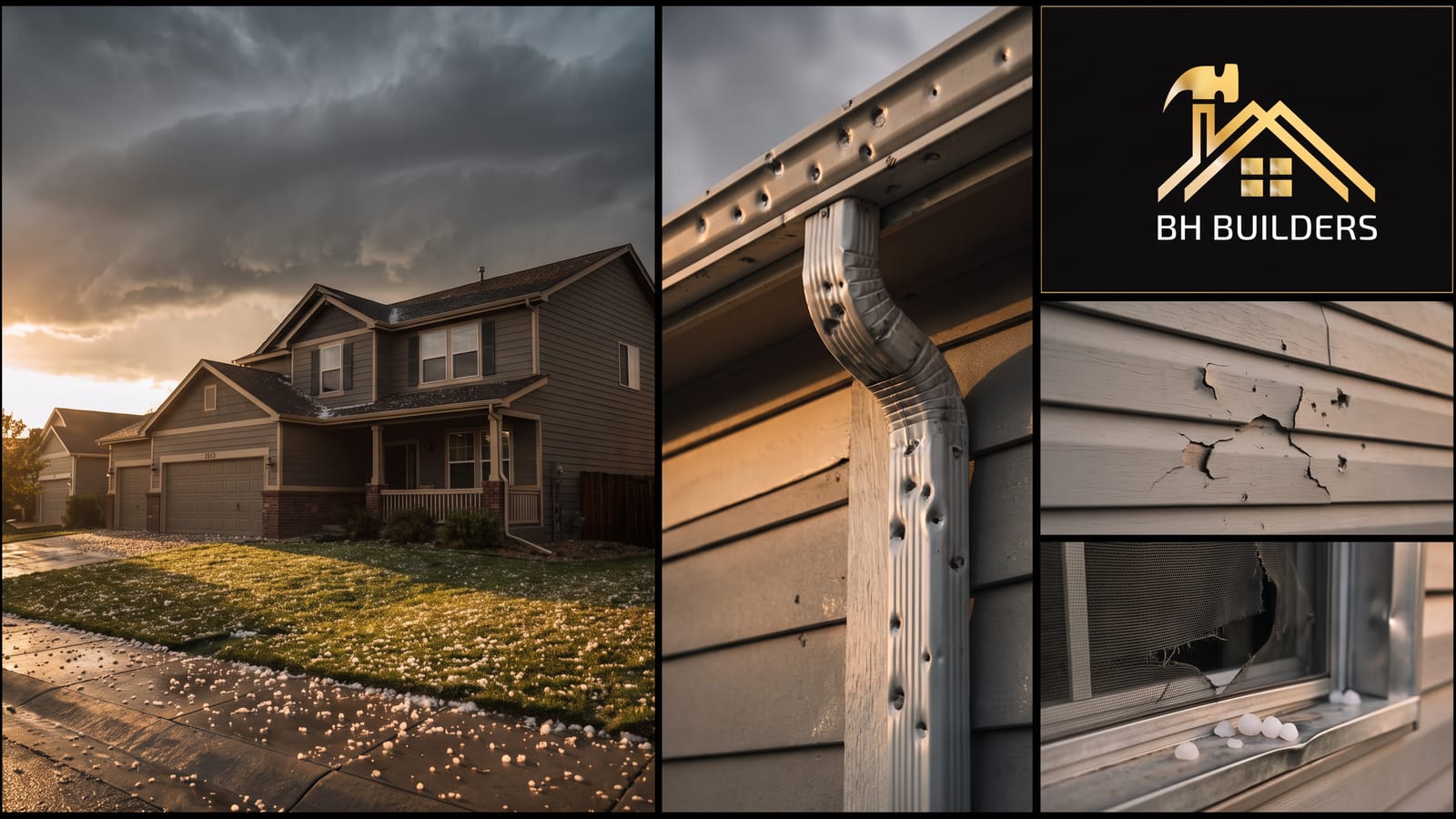
After a hailstorm everybody looks up at the roof. I look at the window screens, the siding, the deck stain and the AC fins. That is where the claims get missed.DT · Owner, BH Builders
 The Front Range sits in the part of the country that gets hit hardest and most often by hail. Storms run from spring into early fall, the worst of them land between May and August, and the damage they do to a house is far broader than the part everybody looks at.
Roofs get inspected because roofs are what the insurance industry is set up to inspect. Meanwhile the gutters, the siding, the window trim, the screens, the garage door, the air conditioner and the deck all took the same barrage, and those are the line items that quietly fall off a claim.
Why exterior damage gets missed
 It is rarely bad faith. After a large storm an insurer may be handling thousands of claims in a small area, often with adjusters brought in from out of state on short assignments. The inspection is fast, the priority is the roof, and anything not obvious from a ladder gets a glance.
Hail damage on walls also hides better than hail damage on shingles. A dent in an aluminum gutter reads as "old" at a distance. A crack in fiber cement can look like normal weathering until you get close. Vinyl siding can be impact-cracked on the back side with almost nothing visible from the front until the sun goes low across it. And when the whole neighborhood is getting new roofs, nobody is looking at the downspouts.
 The result is a claim that pays for the roof and leaves you paying out of pocket for the walls two years later — after the deadline to reopen it has passed.
What to check on a Colorado house after a storm
Walk the whole perimeter, in the morning or late afternoon when the light rakes across the surfaces. Damage that is invisible at noon shows up plainly at a low sun angle.
| Surface | What damage looks like | Why it matters |
|---|---|---|
| Gutters and downspouts | Round dents in the top edge, dimples down the face, split seams | Also the best evidence of hail size and direction — photograph these first |
| Siding | Cracks and holes in vinyl, chips and spider cracks in fiber cement, dents in steel and aluminum | A cracked panel is a water path into the wall assembly |
| Window wraps and screens | Dented aluminum cladding, torn or punched screens, chipped glazing bead | Damaged cladding leaks behind the trim where you will never see it |
| Fascia, soffit and vents | Dents, cracked soffit panels, crushed vent louvers | Crushed vents restrict attic airflow and shorten the new roof's life |
| Roof vents and flashing | Soft metal dents, bent pipe boots, dinged valley metal | Adjusters use these as the confirmation test for hail impact |
| Decks and railings | Pitting in the finish, dents in composite boards, damaged metal railing caps | Frequently covered as "other structures" — and almost never claimed |
| AC condenser | Flattened fin coil on the storm-facing side | Cuts efficiency immediately; cheap to comb out, expensive to ignore |
| Paint and stain | Chipped spots on trim, exposed wood on the storm side | Bare wood on the west and south faces fails fast at altitude |
 Photograph everything with something for scale in the frame — a coin, a tape, a hand — and keep the metadata intact by not screenshotting or re-saving the images. Note the date and the direction the storm came from. If you collected any hail, photograph it against a ruler before it melts.
The deductible is where the real money is
Colorado homeowners policies increasingly carry a separate wind and hail deductible, written as a percentage of the dwelling coverage rather than a flat dollar figure. On a home insured for $600,000, a 2 percent wind and hail deductible is $12,000 before the policy pays anything — a very different situation from the $2,500 all-perils deductible people remember signing up for.
 Find yours on the declarations page before you file anything, because it changes the math completely. If the total damage across roof, gutters, siding and screens is $14,000 and your wind and hail deductible is $12,000, whether the siding makes it onto the estimate is the difference between a claim worth filing and one that is not.
Two more policy details worth reading in the same sitting: whether your roof is covered at replacement cost or actual cash value, and how long you have to report storm damage. Many Colorado policies now limit reporting to a fixed window — often one year from the date of loss — and that clock does not care that you did not notice.
What Colorado law says about roofing contractors
Colorado wrote specific consumer protections into statute after the storm-chaser waves of the last decade, and they are worth knowing because they tell you what a legitimate contractor will and will not do.
- Nobody can pay or waive your deductible. Under C.R.S. 6-22-105, a roofing contractor working on insurance proceeds cannot pay, waive, rebate, or promise to pay or waive any part of your deductible — or advertise that they will. If someone offers, they are telling you they break the law when it suits them.
- You get a written contract with required terms. C.R.S. 6-22-103 sets out what has to be in it, including the notice about the deductible.
- You can rescind after a denial. Under C.R.S. 6-22-104, you may rescind a roofing contract within 72 hours after receiving written notice from your insurer that the claim is denied — you just have to notify the contractor in writing inside that window.
 None of this stops a door-knocker from showing up the morning after a storm. It does give you a clean way to sort them.
If a guy offers to eat your deductible, he is not doing you a favor — he is either breaking the law or building the cost back in somewhere you cannot see. Neither one ends with a better roof.
DT · Owner, BH Builders
Class 4 shingles and Colorado's new roof program
 Class 4 impact-resistant shingles are rated at the top of the UL 2218 impact scale — tested by dropping steel balls onto the same spot twice without cracking the mat. They cost more up front than a standard architectural shingle and they are close to standard practice on Front Range replacements now, for two reasons.
The first is that most Colorado carriers discount the dwelling portion of the premium for an impact-resistant roof. The size varies by carrier and is worth confirming with your agent before you choose a product, because on a hail-exposed house the discount can recover the upgrade over the life of the roof.
 The second is newer. In 2026 the legislature passed SB26-155, creating the Strengthen Colorado Homes Enterprise inside the Division of Insurance. It sets up a grant program to help homeowners retrofit to resilient roof systems, governed by a seven-member board, and funded beginning in 2027 by a fee equal to half a percent of homeowners premiums written in the state. Hail is the single largest cost driver in Colorado homeowners insurance, and this is the state's attempt to spend money on prevention instead of claims.
If you are replacing a roof in the next couple of years, it is worth asking where that program stands when you get to product selection. Our roofing page covers the systems we install and what the differences actually buy you.
Running the claim in the right order
- Document before you call. Photograph the whole exterior, not just the roof. Note the storm date.
- Get an independent inspection. A contractor walking the property before the adjuster arrives gives you a scope to compare against, and finds the wall damage nobody is looking for.
- Read your declarations page. Wind and hail deductible, replacement cost versus actual cash value, reporting deadline.
- File, then be there for the inspection. Meet the adjuster on site with your documentation. Point out the gutters and siding specifically — you are entitled to have all covered damage documented.
- Compare the estimate to the scope, line by line. Missing items are normal and are usually corrected with a supplement rather than a fight.
- Do the work in one pass. Roof, gutters, siding, wraps and paint sequenced together, so nothing gets installed and then torn back off.
 That last point is the one that saves the most money and the most aggravation. Handled as separate jobs, the gutter company comes after the roof, the siding crew comes after the gutters, and someone ends up removing work that was just installed.
What we do on a storm walkaround
Our inspection covers the roof planes, the soft metals, all four elevations of siding and trim, the windows and screens, the deck and railings, and the mechanical equipment. You get photographs and a written scope whether or not you file a claim and whether or not you hire us — it is the same document either way, and it is the thing an adjuster conversation goes better with.
 We handle the whole exterior in one contract, which is the practical argument for calling a general contractor rather than a roofer after a hail storm: the roof is one trade out of four that just got damaged. See exterior remodeling for the rest of it, and if the deck took a beating too, deck repair and replacement.
Storm damage across Denver, Aurora, Centennial, Littleton, Greenwood Village and the surrounding metro — call (720) 980-3913 or request a free inspection.
Keep reading from the BH Builders blog
Hail does not stop at the roofline. Half the damage we find on a walkaround is on the walls, and half of that never made it onto the adjuster report.DT · Owner, BH Builders
Planning a project of your own?
Free, no-pressure estimates across the Denver metro — and four instant calculators.
📞 Call (720) 980-3913 Schedule a Free Meeting